
DA, DOE Move to Protect 3M Hectares from Solar Sprawl

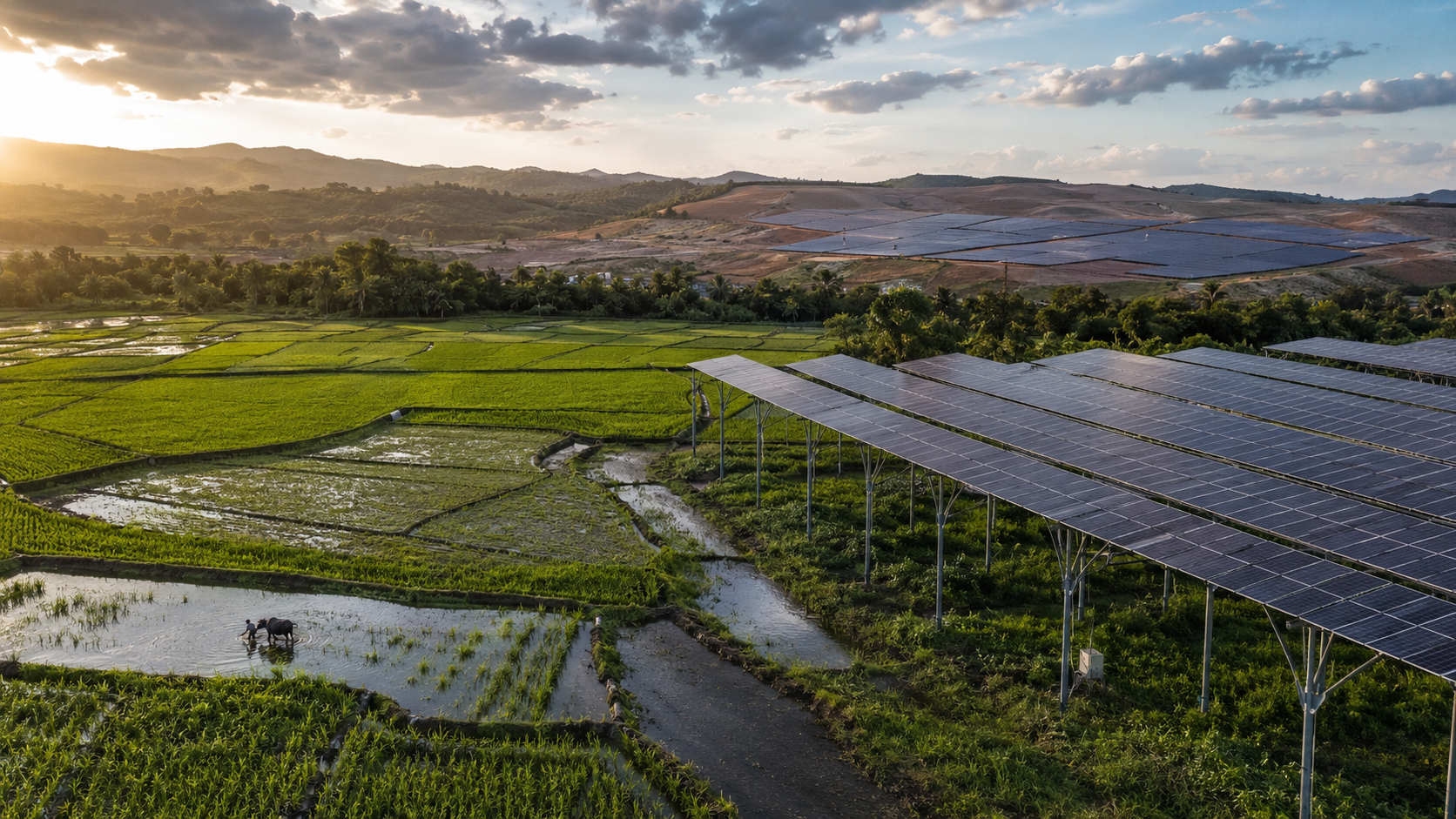
The Department of Agriculture (DA) and the Department of Energy (DOE) are finalizing a landmark joint policy framework to geofence approximately 3 million hectares of prime agricultural flatland. The inter-agency measure is designed to prevent aggressive ground-mounted solar power expansion from displacing critical food production zones across the archipelago.
Spearheaded by Agriculture Secretary Francisco P. Tiu Laurel Jr. alongside senior energy officials, the policy addresses an escalating land-use conflict within the country’s clean energy transition. As power developers scramble to secure vast contiguous parcels of land to fulfill commitments under the Philippine Energy Plan, high-yield rural flatlands—predominantly irrigated rice basins—have faced growing conversion pressures.
Balancing Clean Power and Food Security
Under the forthcoming framework, identified prime agricultural areas will be declared strictly off-limits to standalone, utility-scale ground-mounted solar installations. The initiative establishes clear spatial boundaries, ensuring that the country’s decarbonization targets do not compromise national food security and domestic rice self-sufficiency objectives.
The Philippine government is pursuing an ambitious target to raise the renewable energy share in the national power generation mix to 35% by 2030 and 50% by 2040. However, regulators emphasize that achieving these milestones must not lead to the unintended loss of arable lands essential for feeding a growing population.
To accommodate power sector expansion, the joint policy sets structured guidelines that steer solar developers toward non-arable lands, marginal uplands, and dual-use technological models. Key among these is the institutional promotion of agrivoltaics—co-locating elevated solar arrays that allow crop cultivation or livestock grazing underneath—as well as aquasolar projects on aquaculture ponds and canal-top installations over national irrigation networks.
Regulatory Clarity Ahead of Green Energy Auctions
The geofencing policy arrives at a critical juncture as the DOE prepares for subsequent rounds of the Green Energy Auction (GEA) program, which are expected to award thousands of megawatts in solar capacity. Industry players have frequently cited complex land conversion processes with the Department of Agrarian Reform (DAR) and protracted local zoning clearances as leading drivers of project delays.
By delineating clear geographic demarcations prior to upcoming auction tenders, the government intends to provide solar developers with enhanced regulatory certainty. Projects that integrate agrivoltaic designs or utilize pre-cleared industrial and non-agricultural corridors are expected to benefit from streamlined permitting and reduced community friction.
Furthermore, both agencies plan to coordinate closely with local government units (LGUs) to ensure comprehensive land use plans (CLUPs) reflect the national geofenced zones. This coordinated oversight aims to prevent speculative land banking in vital farming belts.
As the Philippines accelerates its power grid transformation, the DA-DOE accord highlights a maturing energy transition strategy—one that recognizes that decarbonizing the grid cannot come at the expense of agricultural resilience.