
Fuel Retailers Slash Pump Prices by Up to P3.90

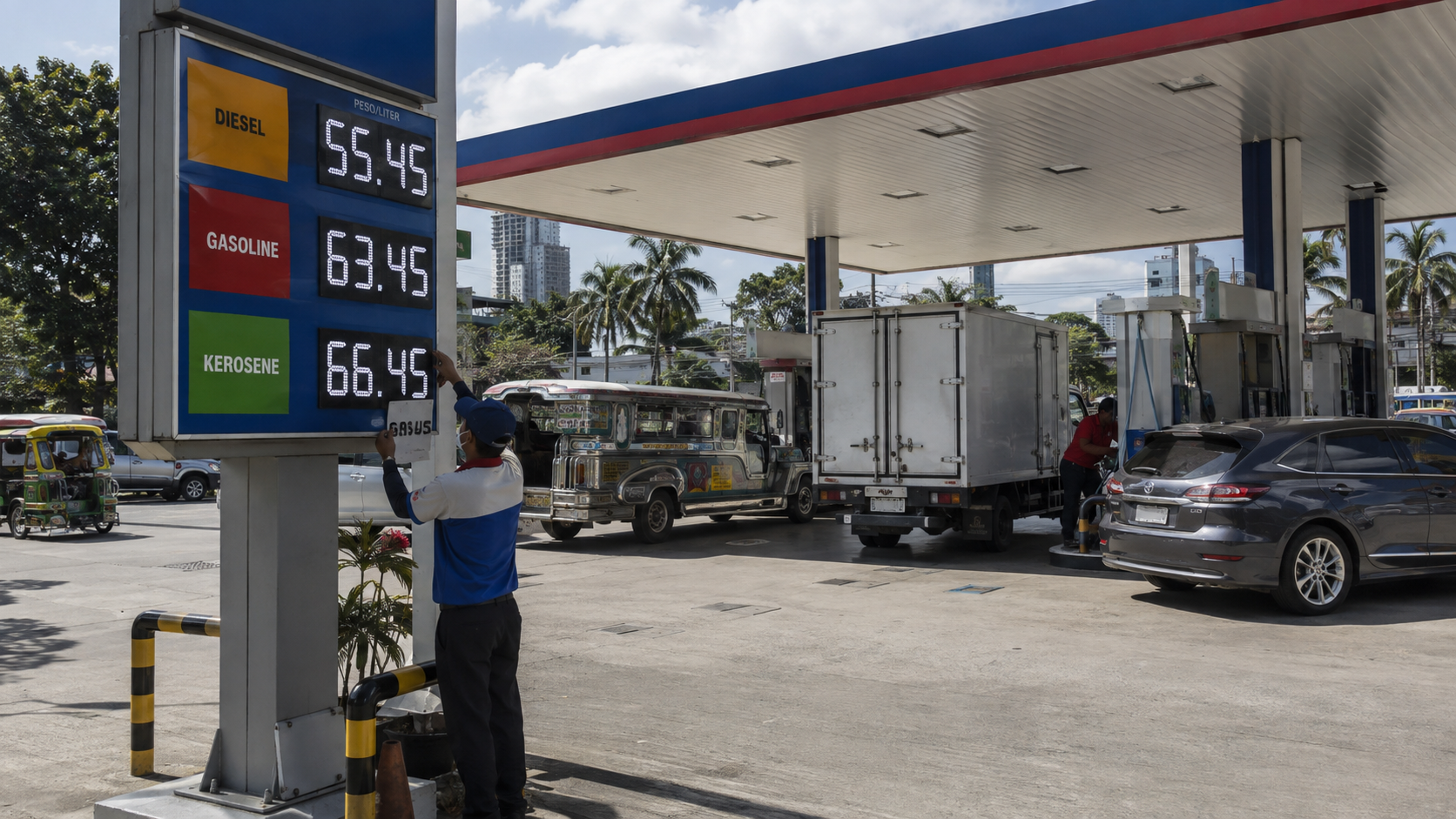
Philippine oil companies announced substantial rollbacks in domestic pump prices effective Tuesday morning, delivering much-needed relief to motorists, commercial transport operators, and logistics providers after two straight weeks of price increases.
In separate advisories released on Monday, major fuel retailers confirmed downward adjustments led by a steep reduction in diesel and kerosene prices, tracking a sharp decline in international petroleum trading benchmarks.
Sizable Cuts Across Petroleum Products
Industry players—including Shell Pilipinas Corp., Petron Corp., Seaoil Philippines, and Unioil Petroleum Philippines—confirmed that diesel prices will decline by P3.80 to P3.90 per liter, while kerosene will see a reduction of up to P3.84 per liter.
Gasoline will reflect a more modest downward adjustment ranging between P0.30 and P0.40 per liter. The revised pump rates take effect simultaneously at 6:00 a.m. on Tuesday across most major retail stations nationwide.
The substantial downward correction snaps a fortnight of consecutive price hikes triggered by tightening regional inventories and heightened geopolitical risk premiums in the Middle East. For commercial transport fleets and agricultural producers that rely predominantly on diesel, this adjustment represents the sharpest single-week price relief recorded in recent months.
Cooling Global Benchmarks Drive Local Relief
According to the Department of Energy (DOE) Oil Industry Management Bureau, domestic pump adjustments directly reflect weekly price movements under the Mean of Platts Singapore (MOPS)—the regional pricing benchmark for refined petroleum products in Southeast Asia.
Energy analysts noted that the retreat in crude and product futures was primarily catalyzed by easing global supply disruptions, coupled with softer demand projections across major Asian and Western industrial economies. The stabilization of crude export lanes and steady output levels from key non-OPEC producers further weighed on speculative premiums across Asian trading desks.
Because the Philippines remains a net importer of finished petroleum goods, local retail rates move in near-lockstep with weekly Singapore benchmark averages, adjusted for freight premiums, foreign exchange fluctuations against the US dollar, and local statutory duties.
Macroeconomic Impact and Market Outlook
This week’s price reduction is expected to ease operating pressure across the logistics and food supply chains, sectors where transport fuel accounts for a significant portion of variable overhead costs. Economists at the National Economic and Development Authority (NEDA) and the Bangko Sentral ng Pilipinas (BSP) have continuously cited volatile energy imports as a key swing factor in non-food headline inflation.
While year-to-date net adjustments for fuel products remain elevated relative to historic baselines, this latest rollback substantially moderates cumulative cost pressures on households and businesses alike.
The DOE continues to advise consumers to observe fuel efficiency practices and utilize official price-monitoring portals to compare localized pump tariffs across competing retail stations. As global energy markets balance shifting demand forecasts against OPEC+ output policies, Philippine consumers and commercial operators must remain agile amid ongoing volatility in international oil trading.